Quick Answer
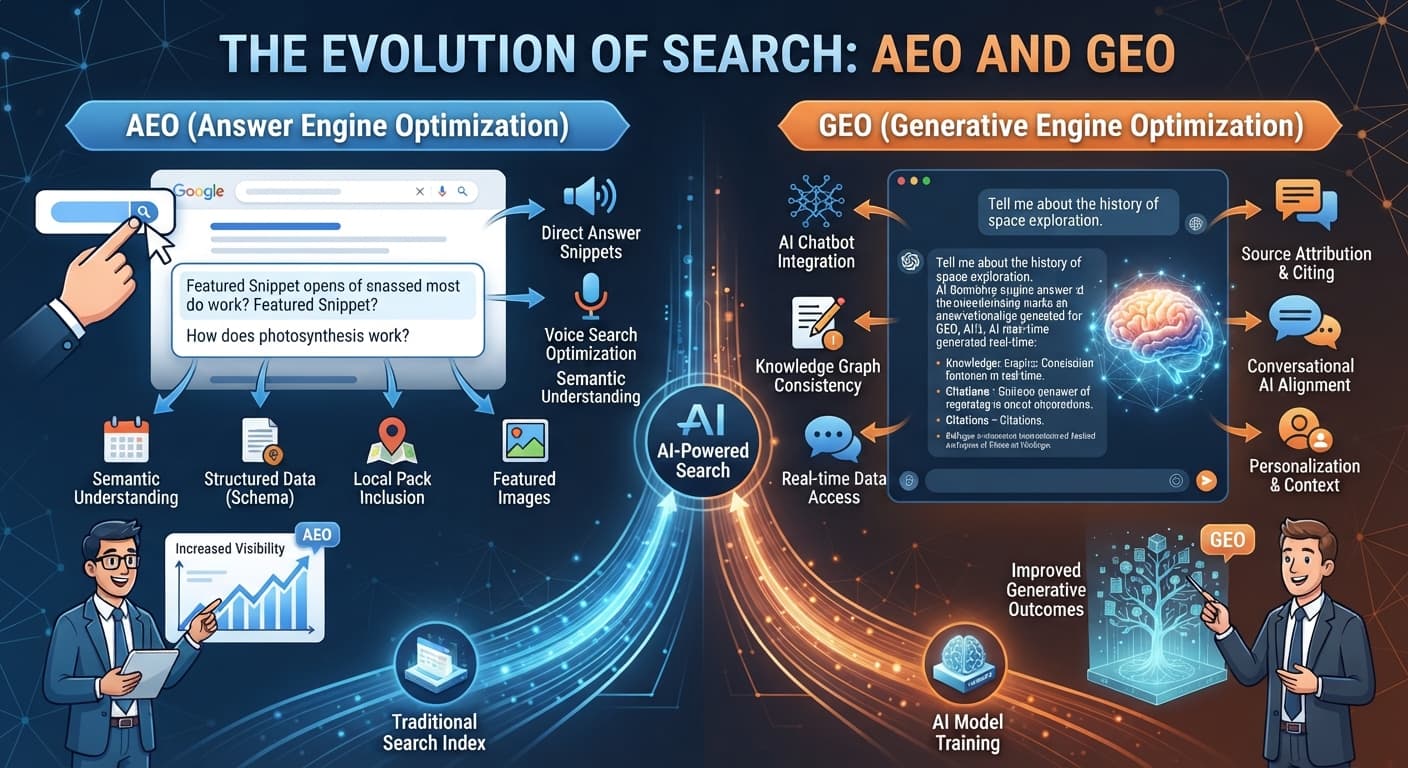
AEO and GEO are two ways of making your content easy for AI-driven search tools to find, understand, and cite. Answer engine optimization (AEO) focuses on giving direct answers that search features and voice assistants can pull out. Generative engine optimization (GEO) focuses on getting your brand mentioned and cited inside AI-written answers from tools like Google AI Overviews, ChatGPT, and Perplexity.
Key points:
Both build on SEO basics: crawlable pages, helpful content, and clear structure.
Direct answers, verifiable facts, and cited sources make content easier to quote.
Consistent brand information across the web supports AI search visibility.
Measure results through Search Console and regular prompt testing.
Ask an AI assistant to recommend a company in your industry, and you’ll usually get a short list of names. If your brand isn’t on that list, you may never get the chance to compete for that customer. That shift is why AEO and GEO have become part of every serious search strategy. People still use search engines, but more of their questions now end in an AI-written answer rather than a list of links. Getting cited inside that answer is the new version of ranking on page one. This guide explains what each approach means, how they differ, and the practical steps that help your brand appear in AI search results.
What Are AEO and GEO?
AEO and GEO are content strategies that help AI-driven search tools choose your pages as sources for their answers.
Answer Engine Optimization (AEO)
Answer engine optimization structures content so a system can lift a clear answer from it. It grew out of featured snippets, People Also Ask boxes, and voice search. Typical AEO work includes question-based headings, short direct answers, and FAQ sections.
Generative Engine Optimization (GEO)
Generative engine optimization aims to get your brand included and cited when an AI model writes a full answer by combining several sources. The term comes from a 2024 research paper on GEO by researchers from Princeton, Georgia Tech, The Allen Institute of AI, and IIT Delhi, which tested how changes to content affect visibility in AI-generated responses.
AEO vs GEO: What Is the Difference?
The main difference is the output. AEO targets a single extracted answer, while GEO targets a mention or citation within a response built from several sources.
Factor | AEO | GEO |
Main goal | Be the direct answer | Be cited or recommended in AI answers |
Where it appears | Featured snippets, voice assistants, answer boxes | AI Overviews, AI Mode, ChatGPT, Perplexity, Gemini |
Content focus | Concise answers to specific questions | Depth, evidence, and brand authority |
Typical signal | Clear question-and-answer formatting | Facts, sources, and consistent brand mentions |
Success measure | Answer placements | Brand mentions and citations |
In practice, the two overlap heavily. A page with strong direct answers and credible evidence serves both.
Why Does Brand Visibility in AI Search Matter Now?
Brand visibility in AI search matters because AI answers now reach a huge audience and reduce clicks to regular results. Google reports that AI Overviews now has over 2.5 billion monthly active users, while AI Mode has surpassed one billion monthly users. Meanwhile, a Pew Research Center analysis found that users who encountered an AI summary clicked on a traditional search result link in 8% of all visits, compared with 15% of visits for those who did not see one.
This means fewer people visit websites to compare options. If an AI answer names your competitor and not you, you lose the customer before they ever see your site. For example, someone asking an AI tool for curtain ideas may only consider the brands it mentions, a growing concern in digital marketing for home decor businesses.
Do AEO and GEO Replace SEO?
No. AEO and GEO extend SEO rather than replace it. Google’s guide to optimizing for generative AI features says generative AI features (such as AI Overviews and AI Mode) rely on its core Search ranking and quality systems. From Google’s perspective, “AEO” and “GEO” are still SEO.
The same guide notes that Google Search doesn’t use llms.txt files, that structured data isn’t required for generative AI search, that there’s no special schema for it, and that you don’t need to break content into small pieces. Other AI tools may work differently, but the lesson is clear: skip the shortcuts and strengthen the fundamentals. The move toward AI search resembles the earlier shift from traditional vs digital marketing. The channel changed, but understanding your audience still decided who won.
How to Optimize Content for AI Search
To optimize content for AI search, make every page easy to understand, easy to verify, and worth citing. These AI SEO strategies work across most platforms:
Answer first. Open each section with a one- or two-sentence answer, then expand.
Add evidence. In the GEO study, adding relevant statistics, quotations, and citations boosted content visibility in generative engines by up to 40%. These were benchmark results, not guarantees, but they show the value of verifiable facts.
Offer original insight. Share first-hand experience, expert views, and data that others don’t have. AI tools have little reason to cite content that repeats what is already available.
Use clear structure. Descriptive headings, lists, and tables help readers and machines follow your content.
Check technical access. Pages must be both indexable and crawlable. Review your robots.txt settings so you don’t block AI crawlers you actually want.
Keep brand data consistent. Your name, services, locations, and contact details should match across your website, Google Business Profile, and directories.
Earn genuine mentions. Reviews, industry features, and partnerships carry real weight. Google says inauthentic “mentions” aren’t as helpful as they seem, and its systems are designed to block spam.
A local service company can apply these principles easily. A page that answers “How long does window installation take?” with real timelines and project details is far more citable than a generic service page. Our guide to marketing strategies for home improvement businesses shows how this kind of content fits into a wider plan.
How to Measure AI Search Visibility
AI search visibility is harder to track than rankings, so combine several signals:
Google Search Console, where sites appearing in AI features (such as AI Overviews and AI Mode) are included in the overall search traffic
Monthly prompt tests in ChatGPT, Perplexity, Gemini, and Google using the questions your customers ask
Referral traffic from AI tools in your analytics platform
Growth in branded searches and direct visits
AI answers change between sessions, so track patterns over several months rather than reacting to a single result. If you need help setting up your strategy, our SEO services cover both traditional search and AI search optimization.
Conclusion
AEO and GEO don’t replace SEO. They are the next layer of SEO. Brands that give direct answers, back their claims with evidence, publish original insight, and keep their information consistent are the ones AI tools trust and cite. Start with your customers’ most important questions, improve those pages, and measure your visibility each month.
If you want a clear plan for improving your brand’s presence in AI search, our team can help. Explore our digital growth strategies and talk to us about your goals.
Frequently Asked Questions
Are AEO and GEO the same thing?
They are related but are not the same. AEO emphasizes being the direct answer to a question, whereas GEO stresses citation in a longer AI-generated answer. It is best for most companies to consider AEO and GEO as one cohesive approach.
How long does it take to appear in AI search results?
There is no set timeframe. Indexed and ranked pages can come up quickly. Fresh websites will generally take some time to develop authority, reviews, and mentions.
Can small businesses compete in generative AI search results?
Yes. AI tools tend to refer to specific and relevant pages rather than just big brands. A small business with thorough local information, correct listings, and positive reviews can get citations for niche queries.
Do I need special tools for AEO and GEO?
No. Search Console, analytics, and manual testing of prompts are sufficient. Be careful when using tools that have access to AI or Google's internal data. Even Google warns against believing such claims.
Does structured data help with AI search optimization?
Structured data isn’t required for Google’s AI features, and there is no special schema for them. It still helps search engines understand your pages and can earn rich results, so it remains good practice.